
IBS food and symptom diary
A free food and symptom diary for IBS. Fill it in on this page or print a blank sheet, with what to write down, the Bristol stool scale and how to spot patterns.

Written by Llorenç Bauza
An IBS food diary is a record of what you eat and drink, how much, and how your gut feels afterwards. Kept for a few weeks, it shows patterns you wouldn’t remember otherwise, and gives your doctor or dietitian something concrete to work with. Fill it in below, or print a blank one.
Add an entry
Your diaryFood and symptom diary
Nothing yet. Entries you add show up here, oldest first, ready to print or download.
| When | Food and drink | Symptoms | 0–10 | Stool | Notes | Delete |
|---|
How bad: 0 (fine) to 10 (the worst). Stool type on the Bristol scale, 1 to 7. · fodmi.app
What to write down
- When you ate, and when symptoms started. They don’t always follow the last thing you ate.
- What you ate and drank, with amounts. With FODMAPs the amount matters: many foods are low in a small serving and high in a bigger one, and FODMAPs from different foods in one meal add up (FODMAP stacking).[3]
- Your symptoms and how bad they were, from 0 to 10: bloating, gas, cramps or pain, nausea, brain fog.
- Your stool type on the Bristol scale below, if you went.
- Anything else you’d want your dietitian to know: stress, a bad night’s sleep, your period, a new medication.
The Bristol stool scale
The Bristol stool scale describes stool form with one number. Types 1 and 2 are hard stools, linked with slow transit and constipation; types 6 and 7 are loose, linked with fast transit and diarrhoea.[1]
| Type | What it looks like |
|---|---|
| 1 | Separate hard lumps, like nuts, hard to pass |
| 2 | Sausage-shaped but lumpy |
| 3 | Like a sausage, with cracks on the surface |
| 4 | Like a sausage or snake, smooth and soft |
| 5 | Soft blobs with clear edges, passed easily |
| 6 | Fluffy, mushy pieces with ragged edges |
| 7 | Watery, with no solid pieces |
How long to keep it
Keep it for as long as you’re working something out. On the low FODMAP diet, that means through the 2 to 6 weeks of the first phase and every reintroduction test, when a diary helps most (how reintroduction works). Before an appointment, a week or two of entries gives your doctor or dietitian a fair picture.
How to read it
- Look for symptoms that follow the same food, or foods from the same FODMAP group, more than once. One bad day isn’t a pattern.
- Check the amounts. A food you handle well at breakfast may cause trouble in a bigger portion, or alongside other foods with the same FODMAP.
- Take it to your doctor or dietitian. UK guidelines recommend doing the low FODMAP diet with a dietitian.[2]
- A diary doesn’t diagnose anything. See a doctor promptly about blood in your stool, weight loss you can’t explain, or symptoms that wake you at night (more warning signs).
Keeping your diary in Fodmi
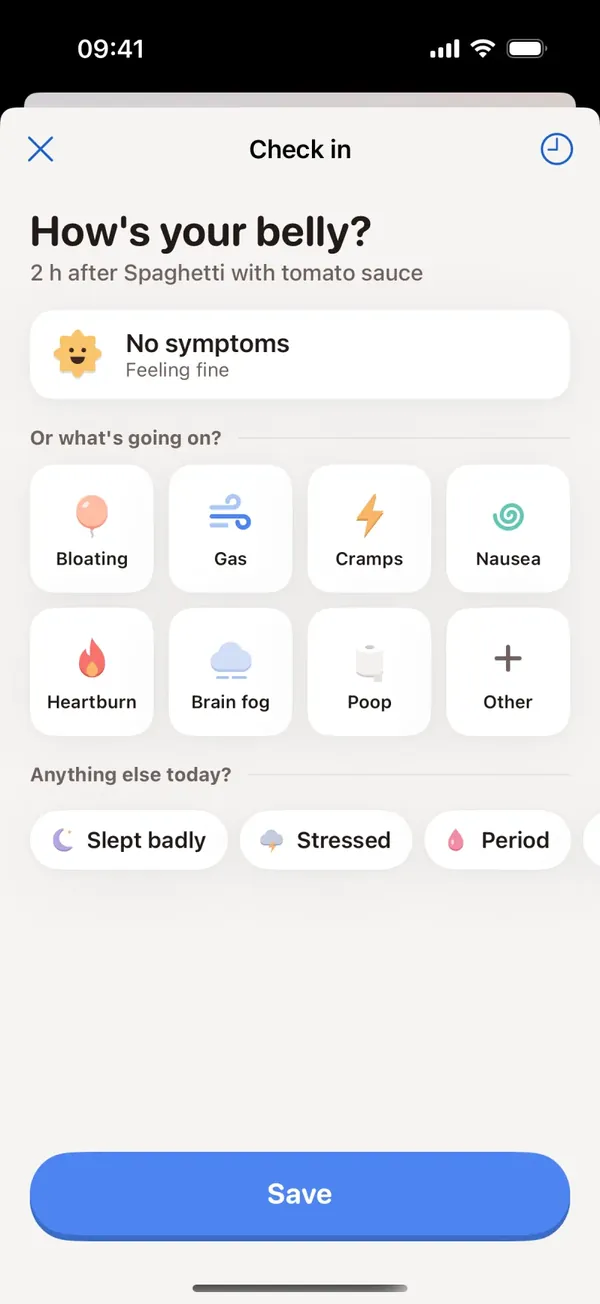
Fodmi is an iPhone app that makes the diary part easier. You log a meal with a photo, your voice or text, see its estimated content across the six FODMAP groups, and check in later on how it sat, with the Bristol stool scale. Over a few weeks, it shows which foods line up with bad days, and you can share a PDF report with your doctor or dietitian. Fodmi’s amounts are estimates from published food composition data, using the low FODMAP cut-offs of Varney et al.[3] It doesn’t replace a dietitian’s plan.
Check your whole plate, not just one food
FODMAPs add up across a meal. Snap your plate in Fodmi to see the total, then check in later on how it sat.


Keep reading


Sources
- Lewis SJ, Heaton KW. Stool form scale as a useful guide to intestinal transit time. Scand J Gastroenterol. 1997;32(9):920–924. doi.org/10.3109/00365529709011203
- Vasant DH, Paine PA, Black CJ, et al. British Society of Gastroenterology guidelines on the management of irritable bowel syndrome. Gut. 2021;70(7):1214–1240. doi.org/10.1136/gutjnl-2021-324598
- Varney J, Barrett J, Scarlata K, et al. FODMAPs: food composition, defining cutoff values and international application. J Gastroenterol Hepatol. 2017;32 Suppl 1:53–61. doi.org/10.1111/jgh.13698
Fodmi estimates FODMAP content from published food composition data. It is not medical advice. Tolerance varies from person to person; follow a low FODMAP diet with a qualified health professional.